MemAnchorWorld: A Sparse World Model with Horizon-Conditioned Memory Retrieval for Autonomous Driving
Abstract
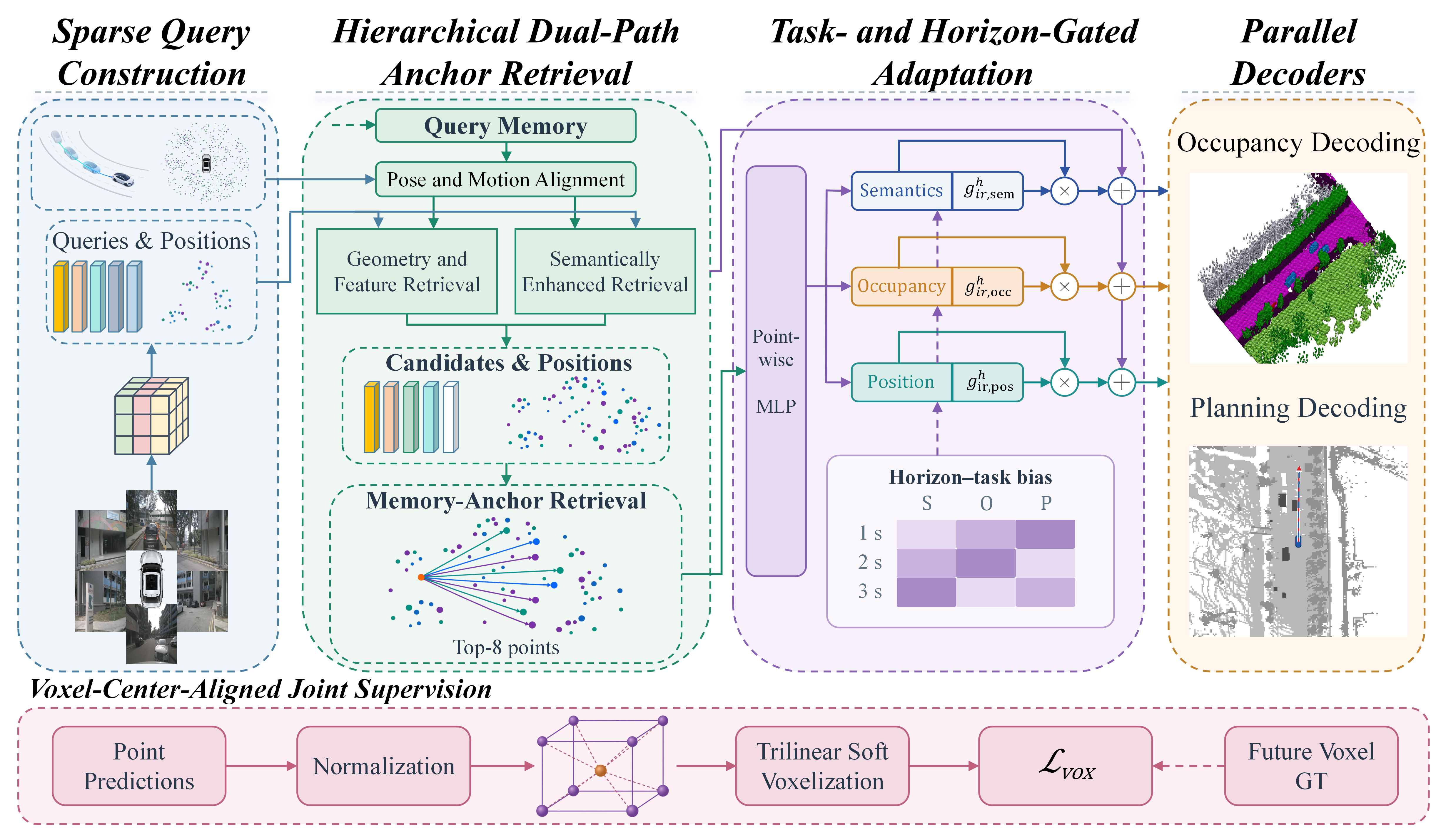
Sparse world models for 4D semantic occupancy forecasting represent scenes with a small set of evolving queries to efficiently predict future geometry and semantics for autonomous driving. However, existing sparse world models face a bottleneck in using historical temporal evidence for long-horizon forecasting. They rely on scene states to carry historical information implicitly, allowing errors to propagate and accumulate across successive forecasting steps and causing geometric and semantic deviations. To address this limitation, we present MemAnchorWorld, a sparse occupancy world model that explicitly retrieves relevant historical geometric and semantic evidence for 4D semantic occupancy forecasting. Inspired by the von Restorff effect, we introduce a forecast-time-conditioned hierarchical dual-path memory-anchor retrieval mechanism. Guided by the effective age and semantic compatibility of historical information, it combines query-level candidate selection with point-level memory-anchor retrieval to provide historical evidence for sparse points at different forecast times. To better use memory anchors and existing features, a point-level residual adapter jointly gated by the task and forecast time separately controls residual corrections to semantics, occupancy confidence, and spatial positions. On Occ3D-nuScenes, MemAnchorWorld achieves an average mIoU of 13.55% and an average IoU of 22.84% across the 1–3 s forecasting horizons, attaining state-of-the-art performance on both metrics. Project page: https://memanchorworld.github.io/.
Method Overview
Retrieve historical memory anchors to refine sparse future predictions.
Results
Occupancy forecasting, motion planning, and component analysis on Occ3D-nuScenes.
| Method | Aux. Sup. | mIoU ↑ | IoU ↑ | ||||||
|---|---|---|---|---|---|---|---|---|---|
| 1s | 2s | 3s | Avg. | 1s | 2s | 3s | Avg. | ||
| OccWorld-S | None | 0.28 | 0.26 | 0.24 | 0.26 | 5.05 | 5.01 | 4.95 | 5.00 |
| RenderWorld | None | 2.83 | 2.55 | 2.37 | 2.58 | 14.61 | 13.61 | 12.98 | 13.73 |
| OccWorld-T | Semantic LiDAR | 4.68 | 3.36 | 2.63 | 3.56 | 9.32 | 8.23 | 7.47 | 8.34 |
| OccWorld-D | 3D Occ | 11.55 | 8.10 | 6.22 | 8.62 | 18.90 | 16.26 | 14.43 | 16.53 |
| PreWorld | 3D Occ | 11.69 | 8.72 | 6.77 | 9.06 | 23.01 | 20.79 | 18.84 | 20.88 |
| PreWorld | 2D & 3D Occ | 12.27 | 9.24 | 7.15 | 9.55 | 23.62 | 21.62 | 19.63 | 21.62 |
| DFIT-OccWorld | 3D Occ | 13.38 | 10.16 | 7.96 | 10.50 | 19.18 | 16.85 | 15.02 | 17.02 |
| SparseWorld | 3D Occ | 14.93 | 13.15 | 11.51 | 13.20 | 22.96 | 22.10 | 21.05 | 22.03 |
| MemAnchorWorld | 3D Occ | 15.39 (↑0.46) | 13.40 (↑0.25) | 11.87 (↑0.36) | 13.55 (↑0.35) | 23.88 (↑0.92) | 22.86 (↑0.76) | 21.78 (↑0.73) | 22.84 (↑0.81) |
| Method | Aux. Sup. | L2 (m) ↓ | Box Collision (%) ↓ | ||||||
|---|---|---|---|---|---|---|---|---|---|
| 1s | 2s | 3s | Avg. | 1s | 2s | 3s | Avg. | ||
| UniAD | Map, Box, Motion, Track, 3D Occ | 0.48 | 0.96 | 1.65 | 1.03 | 0.05 | 0.17 | 0.71 | 0.31 |
| VAD | Map, Box, Motion | 0.54 | 1.15 | 1.98 | 1.22 | 0.10 | 0.24 | 0.96 | 0.43 |
| OccNet | Map, Box, 3D Occ | 1.29 | 2.13 | 2.99 | 2.14 | 0.21 | 0.59 | 1.37 | 0.72 |
| OccWorld-D | 3D Occ | 0.52 | 1.27 | 2.41 | 1.40 | 0.12 | 0.40 | 2.08 | 0.87 |
| RenderWorld-V | 3D Occ | 0.48 | 1.30 | 2.67 | 1.48 | 0.14 | 0.55 | 2.23 | 0.97 |
| PreWorld | 2D & 3D Occ | 0.22 | 0.30 | 0.40 | 0.31 | 0.21 | 0.66 | 0.71 | 0.53 |
| SparseWorld | 3D Occ | 0.19 | 0.25 | 0.36 | 0.27 | 0.11 | 0.29 | 0.46 | 0.29 |
| MemAnchorWorld | 3D Occ | 0.16 | 0.19 | 0.24 | 0.20 | 0.09 | 0.10 | 0.11 | 0.10 |
| Horizon | Hist. compl. | WC correction | CW retention |
|---|---|---|---|
| 1 s | 25.25% | 9.57% | 97.47% |
| 2 s | 24.29% | 11.12% | 97.19% |
| 3 s | 23.19% | 12.58% | 96.64% |
| Memory retrieval | Task–horizon gating | Avg. mIoU ↑ | Avg. IoU ↑ |
|---|---|---|---|
| - | - | 13.20 | 22.03 |
| - | ✓ | 13.31 | 22.34 |
| ✓ | - | 13.24 | 22.25 |
| ✓ | ✓ | 13.55 | 22.84 |
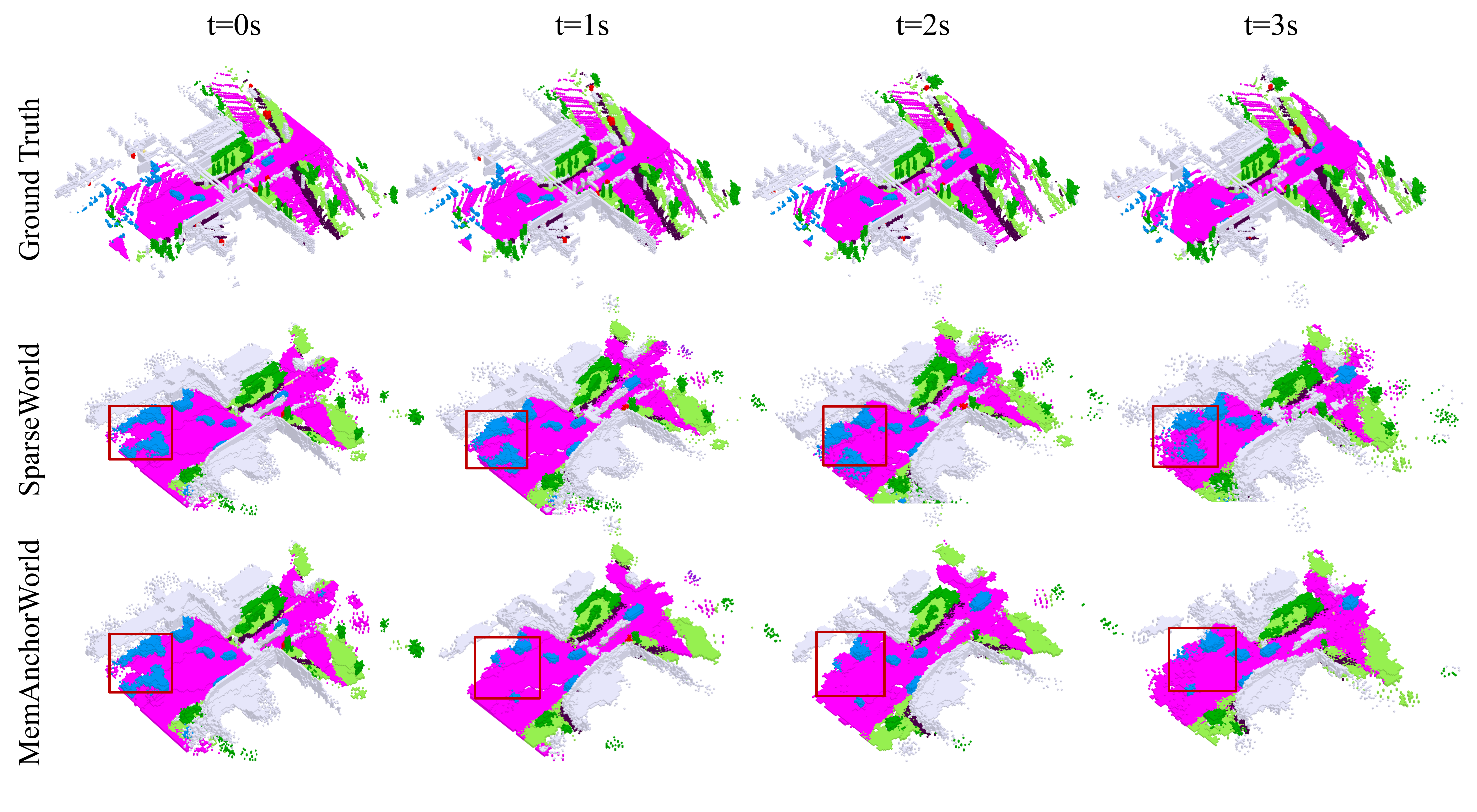
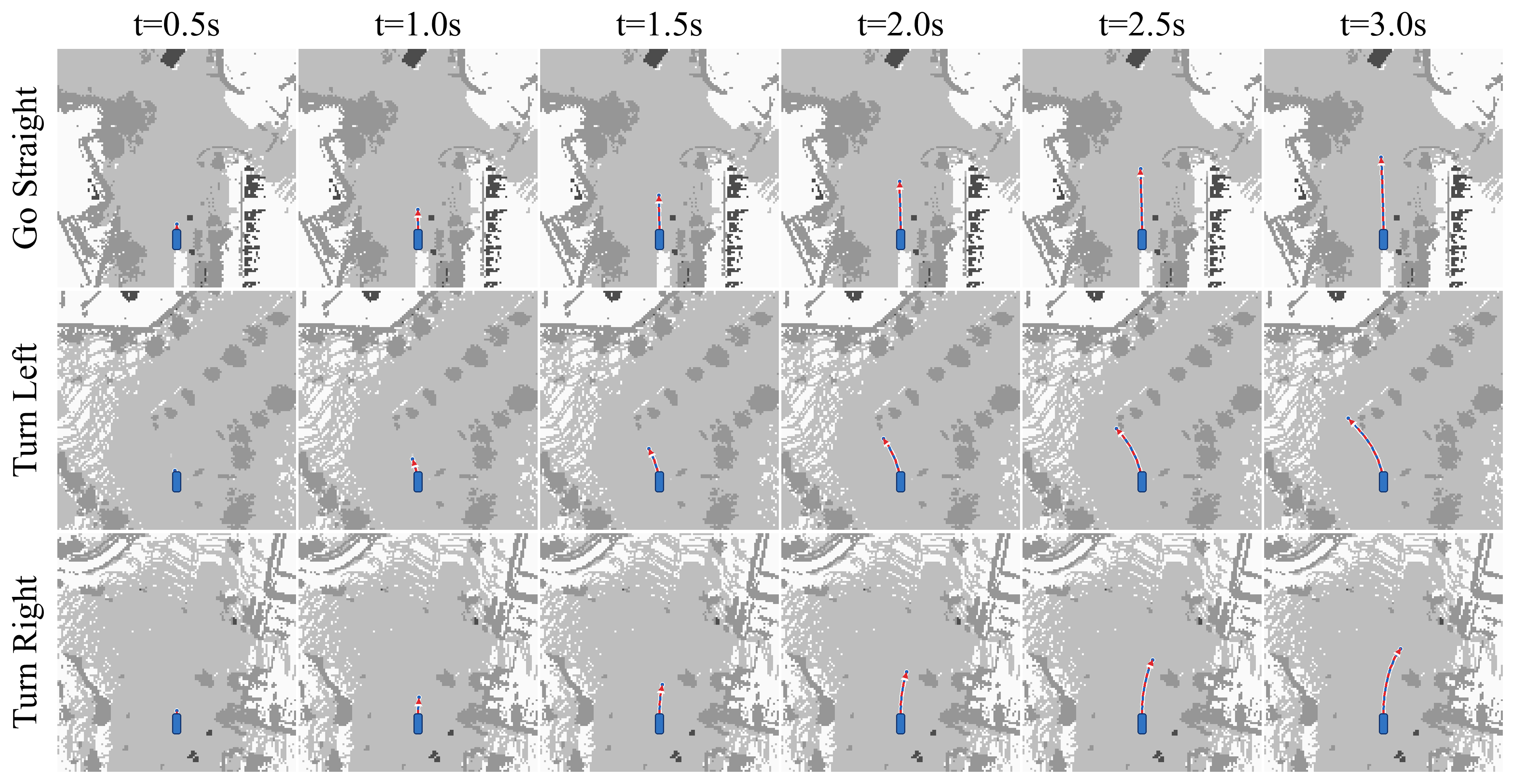
Visualizations
Video unavailable. Open the video file.